

Spain at a Crossroads: Economic Miracle or Statistical Illusion?
An in-depth analysis of Spain’s economic performance between 2024 and 2026, balancing record growth with structural challenges such as the housing crisis and youth unemployment.

Spain at a Crossroads: Economic Miracle or Statistical Illusion?
Special Report | April 2026
“In 2012, The Economist featured Spain on its cover as ‘a wounded nation.’ Today, the same magazine calls it ‘the best-performing economy in the world.’ What changed? And did anything really change?”
In Lisbon, Berlin, and Rome, European economists are asking—with a mix of admiration and skepticism—how Spain managed to become the exception while others stumbled. How did it achieve growth three times higher than Germany, France, and Italy combined in 2024, while Europe struggled under war, inflation, and rising interest rates?
The answer is not simple. And any simple answer—whether celebratory or critical—is misleading.
The numbers that cannot be ignored
Let’s start with what is undisputed: the data is striking.
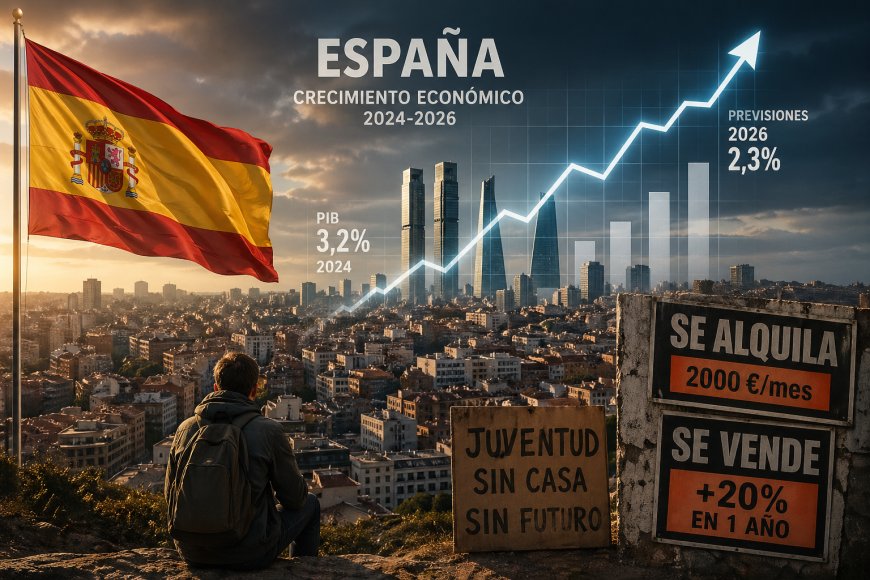
Spain’s GDP grew by 3.2% in 2024—well above government forecasts (2.7%) and nearly four times the European average of 0.9%. In the final quarter, annual growth reached 3.5%, while Germany slipped into recession.
This is no one-off. It marks the fourth consecutive year of growth since the COVID-19 collapse in 2020. The economy now stands 7.6% above pre-pandemic levels.
The labor market tells a similar story:
468,000 jobs created in a single year, unemployment down to 10.6%—its lowest level in 17 years—and a record 21.8 million people employed.
The European Commission is clear: Spain is leading growth in the eurozone and is expected to maintain that position through 2027.
Drivers of growth: who deserves the credit?
Three main factors explain this performance:
1. Tourism — the silent giant
Spain welcomed 94 million tourists in 2024 (+10%), with tourism accounting for roughly 13% of GDP. This success transcends governments—sun, beaches, and cultural heritage remain the true drivers.
2. European recovery funds
Billions from the NextGenerationEU fund have fueled green and digital investments. Spain has been among the fastest in absorbing these funds.
3. Immigration — the quiet demographic engine
According to the OECD, immigration contributed 0.7 percentage points annually to per capita GDP growth between 2022 and 2024, supporting sectors like tourism, construction, and retail.
The harsher reality behind the numbers
For many young Spaniards, this “miracle” feels disconnected from reality.
Housing crisis: the open wound
Rents rose by 11.5% in 2024. In Madrid and Barcelona, they can consume up to 70% of monthly income. Property prices surged by 20% in the capital in just one year.
As a result, 65.9% of Spaniards aged 18–34 still live with their parents, up from 53% in 2008.
Youth unemployment: a structural scar
As of early 2026, it stands at 23.8%—more than double the EU average (15%). Many jobs remain temporary or precarious.
Low productivity: the Achilles’ heel
Since 2008, productivity has lagged 10–15% behind the European average, threatening long-term sustainability.
Political fragmentation: a barrier to reform
With only 152 out of 350 seats, the government struggles to pass major reforms, particularly in housing, education, and taxation.
What do international institutions say?
The OECD praises Spain’s recovery as “broader-based and less reliant on foreign capital” than previous cycles, but warns about demographic aging and future fiscal pressure.
The European Commission forecasts growth of 2.9% in 2025 and 2.3% in 2026—still strong, but slowing.
ESADE Research summarizes the situation clearly: three major challenges—political fragmentation, low productivity, and the housing crisis—threaten to turn this recovery into a temporary surge rather than a sustainable model.
Conclusion: a question without a simple answer
Spain in 2026 is neither a miracle nor a failure.
It is an economy succeeding in quantitative growth while struggling to deliver qualitative social progress.
Investors in Davos may celebrate the numbers. But for a young person in Barcelona paying €2,000 for a room, the reality is very different.
The real question is not:
“Is Spain growing?”
The real question is:
“Who is that growth benefiting?”
And for now, that question remains unanswered.
What's Your Reaction?
 Like
1
Like
1
 Dislike
0
Dislike
0
 Love
0
Love
0
 Funny
0
Funny
0
 Wow
0
Wow
0
 Sad
0
Sad
0
 Angry
0
Angry
0






)




Comments (0)